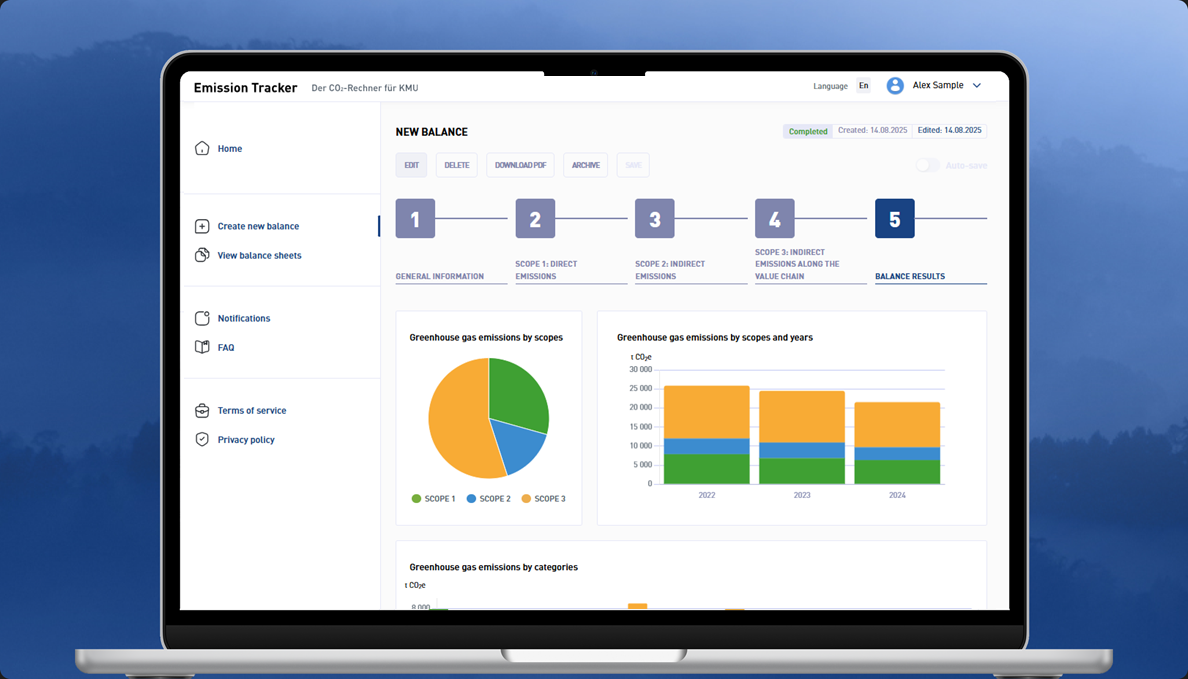
With a compliant greenhouse gas (GHG) balance, you create transparency about your emissions and meet the requirements of customers, banks, and ESG regulations.
Only by knowing your own CO₂ footprint can you take targeted measures to reduce it. Creating a CO₂ balance for your company is the foundation for identifying emission hotspots and developing a long-term climate strategy. Additionally, CO₂ balancing is relevant in the context of legal requirements and in response to the growing expectations of customers and investors.
What is a CO2 Balance for a Company
A CO₂ balance for a company – also known as Corporate Carbon Footprint (CCF) – accounts for all greenhouse gas emissions resulting from a company’s operations. The term “greenhouse gas balance” (GHG balance) is more accurate, as it includes not only CO₂ but also other climate gases such as methane (CH₄) or nitrous oxide (N₂O).
To make emissions comparable, they are converted into CO₂ equivalents (CO₂e) based on their respective global warming potential. Both direct emissions (e.g., from own facilities or vehicles) and indirect emissions (e.g., from purchased energy or the upstream value chain) are quantified. The CO₂ balance thus forms the basis for transparency, climate strategies, and ESG reporting.
What is the Difference Between Corporate Carbon Footprint and Product Carbon Footprint?
Unlike the Corporate Carbon Footprint, the Product Carbon Footprint (PCF) focuses exclusively on the emissions that occur over the lifecycle of a single product or through the provision of a service.
Why Should a Company Create a CO2 Balance?
A CO₂ balance offers companies various strategic and regulatory advantages: