en

CO2 Balance for Your Company

Clouds in the sky symbolizing greenhouse gas emissions and CO₂ in the atmosphere

With a compliant greenhouse gas (GHG) balance, you create transparency about your emissions and meet the requirements of customers, banks, and ESG regulations.

Only by knowing your own CO₂ footprint can you take targeted measures to reduce it. Creating a CO₂ balance for your company is the foundation for identifying emission hotspots and developing a long-term climate strategy. Additionally, CO₂ balancing is relevant in the context of legal requirements and in response to the growing expectations of customers and investors.

What is a CO2 Balance for a Company

A CO₂ balance for a company – also known as Corporate Carbon Footprint (CCF) – accounts for all greenhouse gas emissions resulting from a company’s operations. The term “greenhouse gas balance” (GHG balance) is more accurate, as it includes not only CO₂ but also other climate gases such as methane (CH₄) or nitrous oxide (N₂O).

To make emissions comparable, they are converted into CO₂ equivalents (CO₂e) based on their respective global warming potential. Both direct emissions (e.g., from own facilities or vehicles) and indirect emissions (e.g., from purchased energy or the upstream value chain) are quantified. The CO₂ balance thus forms the basis for transparency, climate strategies, and ESG reporting.

What is the Difference Between Corporate Carbon Footprint and Product Carbon Footprint?

Unlike the Corporate Carbon Footprint, the Product Carbon Footprint (PCF) focuses exclusively on the emissions that occur over the lifecycle of a single product or through the provision of a service.

Why Should a Company Create a CO2 Balance?

A CO₂ balance offers companies various strategic and regulatory advantages:

Legal Requirements: CO2 Balance Obligation for Companies

Both the EU and Switzerland have legal requirements for CO₂ balancing, primarily affecting large companies:

  • EU – Corporate Sustainability Reporting Directive (CSRD): The creation of greenhouse gas balances becomes mandatory for companies with over 1,000 employees and a net turnover of over €450 million under the Omnibus Reform.
  • EU – Ecodesign Regulation (ESPR):In 2026, mandatory CO₂ footprints for specific product groups (PCFs) will be introduced through delegated acts.
  • Switzerland – Code of Obligations (OR): Large “public interest companies” (publicly listed companies, banks, insurers) must create a CO₂ balance (CCF). This applies to companies with at least 500 full-time employees and a balance sheet total of over CHF 20 million or a turnover of over CHF 40 million (Art. 964a et seq. OR).

Benefits of a Climate Balance for Companies

Companies benefit from CO₂ balancing in various ways. Particularly for small and medium-sized enterprises (SMEs), voluntarily creating a greenhouse gas balance is a good idea:

  • Cost & Risk Management: A CCF provides transparency on resource consumption and enables targeted cost reduction and proactive management of CO₂ price increases.
  • Brand & Market Position:Consumers prefer companies with transparent climate data. A professional CO₂ balance minimizes greenwashing risks and fosters customer loyalty.
  • Financing & Evaluation: Financial institutions consider climate risks. A standard-compliant CO₂ balance improves financing conditions and increases attractiveness to investors.

Carbon Footprint Consulting: Our Services around CCF & PCF

Creating a Corporate Carbon Footprint (CCF)

We create CO₂ balances for companies based on the Greenhouse Gas Protocol (GHG Protocol), using both the Corporate Standard and the Corporate Value Chain (Scope 3) Standard, with a special focus on emissions along the value chain. We also offer balancing according to ISO 14064-1.

CCF Verification and ISO Audit

To increase the quality and credibility of your climate balance, we offer the possibility of an external audit of the balance, specifically an audit according to ISO 14064-3. This is a powerful tool to secure credibility with stakeholders, customers, authorities, and investors.

Creating a Product Carbon Footprint (PCF)

For product-related emissions balances, we use the ISO 14067 standard family. Additionally, we can create complete Life Cycle Assessments (LCA) for your products according to ISO 14040/44, which capture not only emissions but also many other environmental data.

Our Approach – 4 Steps to a Reliable CO2 Balance

With over 10 years of experience, we follow a clearly structured methodology when creating your Corporate Carbon Footprint. This ensures that you receive reliable, comparable, and strategically useful results.

  1. Defining System Boundaries and Base Year: Together, we define the relevant locations, companies, and emission sources, as well as a suitable base year.
  2. Data Collection: We collect all relevant data from existing systems and ensure that the foundation is solid and audit-ready.
  3. Emission Calculation Using recognized emission factors, we convert activity data into CO₂
  4. Analysis and Reduction Strategies: We identify emission hotspots, prioritize measures, and, if desired, assist in developing climate goals (e.g., according to the Science Based Targets Initiative, SBTi).

Costs & Offers for Our Carbon Footprint Consulting

The prices for creating or verifying a greenhouse gas balance depend on several factors. Key variables include the number of locations and companies, the availability and quality of data, the complexity of the value chain (especially Scope 3), and the desired standard (e.g., GHG Protocol, ISO 14064). A reliable cost estimate can therefore only be provided based on the specific scope of the project. We are happy to provide you with a tailored offer.

Special Offer: Entry-Level Balance at a Fixed Price

For SMEs, we offer a pragmatic introduction to carbon balancing: a thorough initial assessment of emissions for EUR/CHF 3,000. This includes:

  • Greenhouse Gas Balance (Scope 1 & 2): Complete calculation of direct and energy-related emissions according to the Greenhouse Gas Protocol.
  • Rough Estimation of Scope-3 Emissions: Identification of key indirect emission sources and prioritization of relevant categories.
  • Transparent Result Preparation: Delivery of all calculations in a structured Excel file, along with a presentation of the results in a PowerPoint report, including an online meeting.
  • Action List: Concrete, prioritized recommendations for short- and medium-term emission reductions.

This gives you a clear understanding of where the biggest emission drivers lie and where further analysis would provide the greatest value. It also simplifies planning the next steps, such as developing a reduction pathway, creating a Product Carbon Footprint, or drafting a comprehensive sustainability strategy.

Create a CO₂ Balance for Your Company Yourself

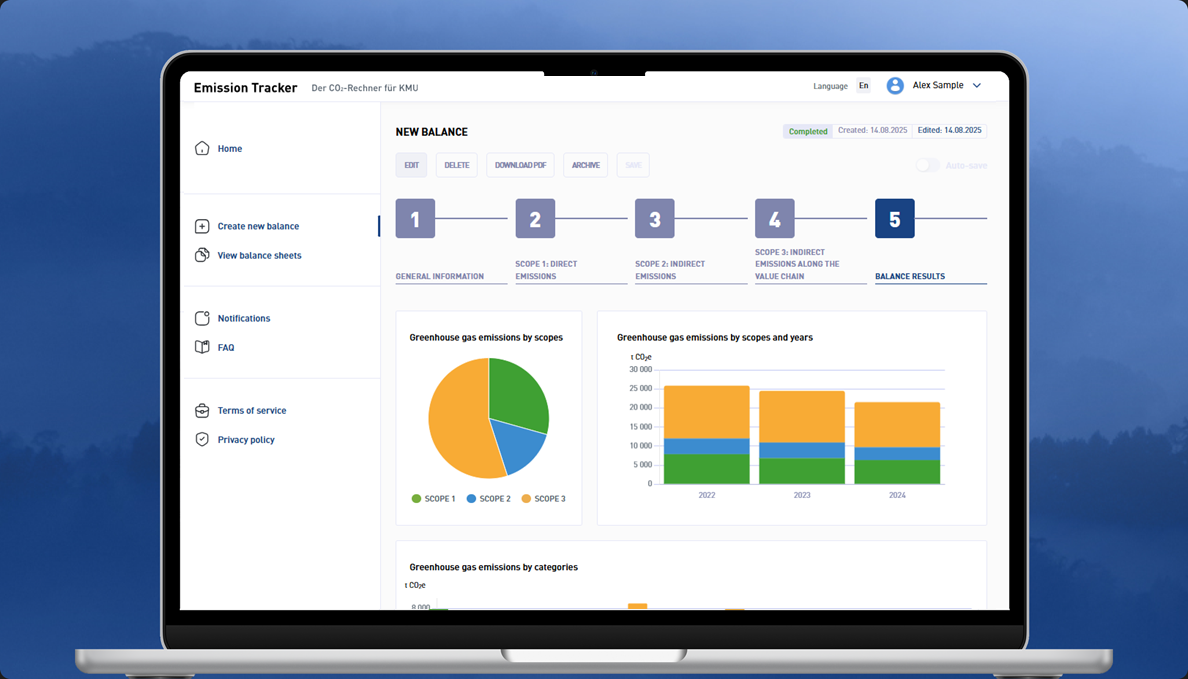
For smaller businesses that do not require a standard-compliant greenhouse gas balance, affordable entry-level tools offer a quick and easy way to gain an initial overview of their emissions. One such tool is the Emission Tracker, which enables SMEs to create a CO₂ balance for all three scopes in just four steps, following the Greenhouse Gas Protocol.

Compared to free online tools, the Emission Tracker offers significantly higher user-friendliness. It has been specifically developed to meet the needs of small and medium-sized enterprises, ensuring that data input is simple, intuitive, and time-saving. This tool provides a solid basis for decision-making, helping companies take their first steps towards a comprehensive climate strategy—without significant bureaucratic effort.

Create Your CO2 Balance Now and Future-Proof Your Company

Let us help you create the CO₂ balance for your company and lay the foundation for a sustainable reduction of your emissions. We will guide you through the entire process: from data collection to concrete reduction measures.

Your Contacts for CO₂ Balances

Co-Managing Director of the Zurich Location
Business Division Environment & Resources

Martina Alig

Managing Director of the Berlin and Hamburg Locations

Dr. Lisa Winter