
Durability bonus for clay bricks in building life cycle assessment
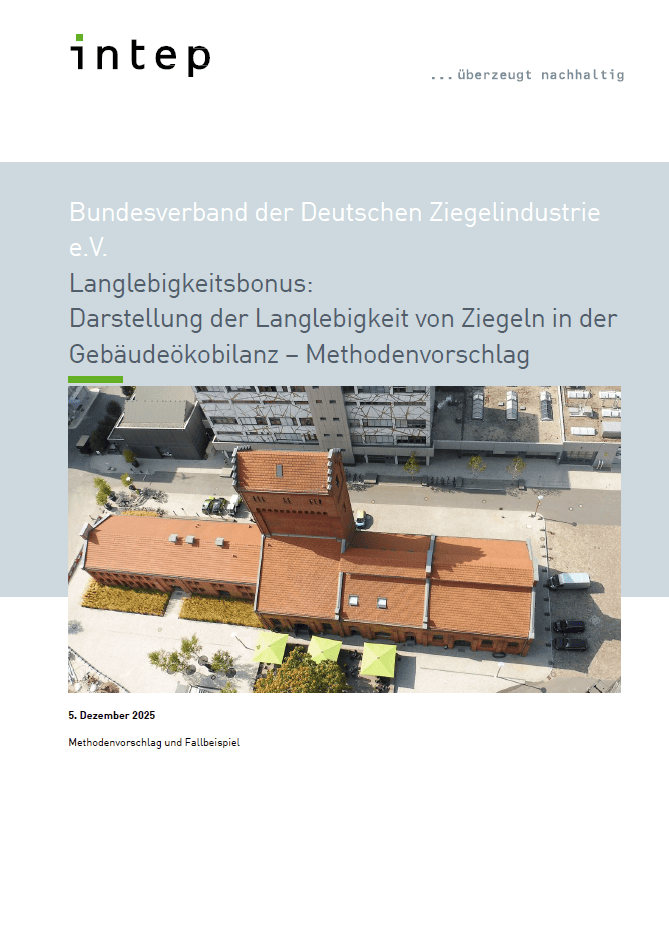
The study conducted by intep on behalf of the German Brick and Tile Industry Federation (Bundesverband der Deutschen Ziegelindustrie e.V.) shows that current life cycle assessment practice systematically underestimates the real environmental benefits of durable building materials such as clay bricks. With the „durability bonus“, intep proposes a standard-compliant method that corrects this disadvantage within the existing 50-year reference study period.
The environmental assessment of buildings is generally based on a fixed reference study period of 50 years. Within this system, clay bricks perform no better than shorter-lived alternatives, despite demonstrated service lives of 100 years and more. Given that around two thirds of all German residential buildings were built in brick construction and are already more than 50 years old, there is a considerable gap between the method and the reality of the building stock.
The proposed method addresses precisely this gap. By means of an opening clause, a building-specific correction factor and a durability scenario, the global warming potential of a building can be adjusted in a standard-compliant manner without abandoning the standardised reference study period. The basis for this is DIN EN 15978. The case study of a monolithic brick residential building shows that, with a declared reference service life of 150 years, the corrected GWP falls by around 8 % compared with the baseline scenario – and by almost 19 % if climate neutrality by 2045 is assumed.
The approach connects directly to existing assessment systems such as QNG and BNB, as well as to the requirements of the revised EU Energy Performance of Buildings Directive (EPBD). intep sees the proposed method as a contribution to the methodological development of building life cycle assessment: the aim is not to give preferential treatment to individual building materials, but to reflect the actual life cycle of buildings more accurately in the assessment. Durable construction is thereby given the weight in environmental assessment that it already has in building practice.


Contact
Dr. Claudia Lösch


Dr. Johanna Pohl

